



When is the grass too green? “Toxic” forever chemicals sprayed on Skåne golf courses
When is the grass too green? “Toxic” forever chemicals sprayed on Skåne golf courses
Our investigation finds that at least 27 golf courses in Skåne have received permits to spray pesticides containing PFAS “forever chemicals”. Experts say there is “no safe level”.
In Kungsmarken naturreservat, east of Lund, you are not allowed to have a dog off leash, to pick plants, or to otherwise “disturb the surrounding environment”. What you can do, is to spread a chemical pesticide that scientists say is “toxic” to aquatic and plant life – if you are a golf course that is.
Within the Natura 2000 site and reserve lies Lunds Akademiska Golfklubb, a club that is proud of its preservation efforts. Visiting on a sunny day in June, while ducking flying golf balls, we observed blooming flowers, fishes in the stream, and the occasional bumble bee. One thing that was not visible to the naked eye, however, is the fluorinated fungicide Fludioxonil that has been sprayed on the greens.
Fludioxonil belongs to a group of chemicals dubbed “forever chemicals”. Thanks to their extremely stable chemical structure, forever chemicals – a.k.a PFAS – essentially don’t break down. The various PFAS molecules – of which there are many – have been linked to a host of health problems, from cancers to infertility to diabetes, and they are used everywhere – in waterproof clothing, firefighting foam, food packaging, and medicines and, indeed, the pesticides used to keep Skåne’s golf courses neat and green.
We know about the golf courses through research carried out by Fältbiologen’s investigative team. Back in March, we sent an allmän handling request out to all 33 municipalities in Skåne, requesting all permits and spray logs regarding chemical pesticides on golf courses over the last five years. Across the municipalities that responded, we found 27 golf courses with either permits or spray logs indicating the use of at least one PFAS pesticide.
Compared to many of them, Lunds Akademiska Golfklubb’s occasional use of Fludioxonil looks like nothing. Just down the road, spray records show that Naturligtivis Golfklubb sprayed five chemical pesticides containing three kinds of PFAS chemicals in a single year. Indeed, it is not unusual for a golf club to have permits for eight different chemical pesticides at the same time. Like LAGK, several golf courses spraying PFAS pesticides are located inside nature reserves.
“They are designed to kill”
The Swedish golf industry argues that their use of chemical pesticides is safe. The redaktör of Svensk Golf, writes on pesticides: “The rules for spraying are simple: It must be harmless to people and animals, it must stick to the ground and not be spread by the rain, and it must break down quickly. Nowadays, pesticides are specific and can target the exact fungus that is destroying the grass with surgical precision.”
Hans Muilerman, campaigner at Pesticide Action Network, disagrees. In response to the quote, he tells us: “Pesticides are never harmless – they are designed to kill. Especially the breakdown claim is laughable. PFAS pesticides do not break down quickly, and their metabolites will remain in the soil and groundwater forever.”
The brands most used on golf courses in Skåne are fungicides Medallion and Instrata Elite, which both contain Fludioxonil. According to scientific studies, Fludioxonil and in particular the products it breaks down into, pose a “toxic” and “serious” threat to pollinators, aquatic animals and plants, mammals, birds, and plants. That’s not to mention its effects on humans.
“We know generally, from PFAS substances… endocrine disruption is one issue. They affect the thyroid hormone system. This can have all sorts of health effects, but the most sensitive part of a developing organism is the brain. In the case of Fludioxonil it’s also suspected to be a reproductive toxicant.” says Professor Joëlle Rüegg, researcher in Environmental Toxicology at Uppsala University.
Besides Fludioxonil, our research shows that Skåne golf courses also frequently use PFAS pesticides which break down into an even more problematic PFAS substance: TFA. Because so many different chemicals break down into TFA, its concentrations in the groundwater are 100 to 1000 times higher than other PFAS, according to Naturskyddsföreningen. Studies suggest that TFA could damage liver function in humans, and the EU recently classed it as a reproductive toxicant based on animal studies, meaning it could harm unborn children. This is relevant, since tests show low levels of TFA present essentially everywhere – in rivers, drinking water, in human bloodstreams and even in breast milk.
An orchestrated lobbying and disinformation campaign
In 2025, Joelle, along with two other researchers in ecotoxicology, wrote an op-ed calling for a complete ban on all PFAS products, in which they called their continued use “one of the biggest environmental scandals in modern times”.
The idea of a ban is not so far from reality – a ban of all PFAS substances is being discussed at the EU level. However, the process is slow, and the chemical industry is reportedly conducting an “orchestrated lobbying and disinformation campaign” in the vein of climate denialists, to try to prevent or water down the ban. One way they are doing this is trying to expand the “essential use” clause, which would exempt PFAS used in medicines from the ban until viable alternatives are found.
The situation on the local level is similar. In Sweden, municipalities are in charge of approving or denying the use of chemical pesticides on golf courses, as long as the pesticides are approved for use by the Swedish chemical agency. The legislation does acknowledge the dangers of PFAS pesticides, limiting the concentrations that can be used per hectare of land, and restricting use in water protection areas.
On paper, under the Miljöbalken and EU law, chemical pesticides should be used as a last resort, after all “natural” or “mechanical” methods for removing pests (such as removing them by hand) have failed. In practice, it seems that golf courses do not have to do much to prove that they have tried other methods. For example, in the permit applications to municipalities, golf courses are asked to justify why non-chemical methods have not worked, and why chemical methods are necessary. In response, one golf course wrote,: “Mechanical means help to a certain extent, but only plant protection products help against snow mold, dollar spot, etc. The same applies to dandelions, weeds, etc.”. This application was approved. In fact, in the cases we received by allmän handling, across 26 municipalities, not a single application was rejected.
The logic is that the amounts of these chemicals permitted are small. It is true that the concentrations in drinking water of many PFAS substances have not reached concentrations that would be expected to harm humans. For Joelle, however, the nature of the chemicals means that this argument does not hold up:
“Persistent chemicals, even if they are not very toxic in small amounts, will build up and reach concentrations that are problematic.” Asked if there is any safe level for spraying PFAS substances, she simply replies “no”.
The end of fludioxonil, the end of golf?
For golf courses that rely on chemical pesticides to keep the grass green, a potential PFAS ban could sound like a death sentence for their businesses.
And this is not just speculation.Take the case of Delsjö Golfklubb, in Gothenburg. In the year 2000, long before PFAS had even entered the public radar, Länsstyrelsen banned the club from using all chemical pesticides due to the fact it was inside a water protection area. Since Delsjön provides drinking water to the residents of Gothenburg, the municipality decided the risk was too high, after pesticide residues were detected in samples.
Within a few years without pesticides, the course became “unplayable”, as 90% of the grass was gone – plagued by a black mold infestation. The club reportedly lost 2-3 months of income.
However, there was a light at the end of the tunnel. In 2003, the club decided to invest around 5 million kronor in digging up their greens and replacing them with a hardier species of grass and much better drainage. It worked. Over 20 years later, the golf course is still going strong, with no need for chemical pesticides.
There are several in Skåne that have followed suit: Woodlands Country Club, Elisefarm Golf Club and Hylliekrokens Golf, to name a few. A representative from one of the golf clubs told us that, while was difficult to manage a golf course, promoting biological elements in the soil can make it more resilient to pests, which works well without pesticides.
“Golf courses today exist all over the country, and it’s really big areas that are used for these kind of amusements. There are alternatives to doing this and they should be informed about that and I think they should put pressure on them to use less toxic and environmentally problematic compounds.” Says Professor in Public Health Science, Carl-Gustaf Bornehag.
“Golf courses are just one example of many unessential uses of PFAS prevalent here in Sweden, and across the globe. There are approximately 10,000 man-made PFAS compounds currently being used in a variety of industries and products, and have been for decades. We will never ever learn everything about PFAS but we have enough science to say – let’s get rid of these compounds now.”
The golf courses mentioned in the article have been contacted for comment.
By Helena Homelius, Rasmus Gunder Eriksen, and Frances Mills.
This investigation comes from the Environment Detectives project, where young people have the opportunity to learn about investigative journalism with a focus on the environment.
Read more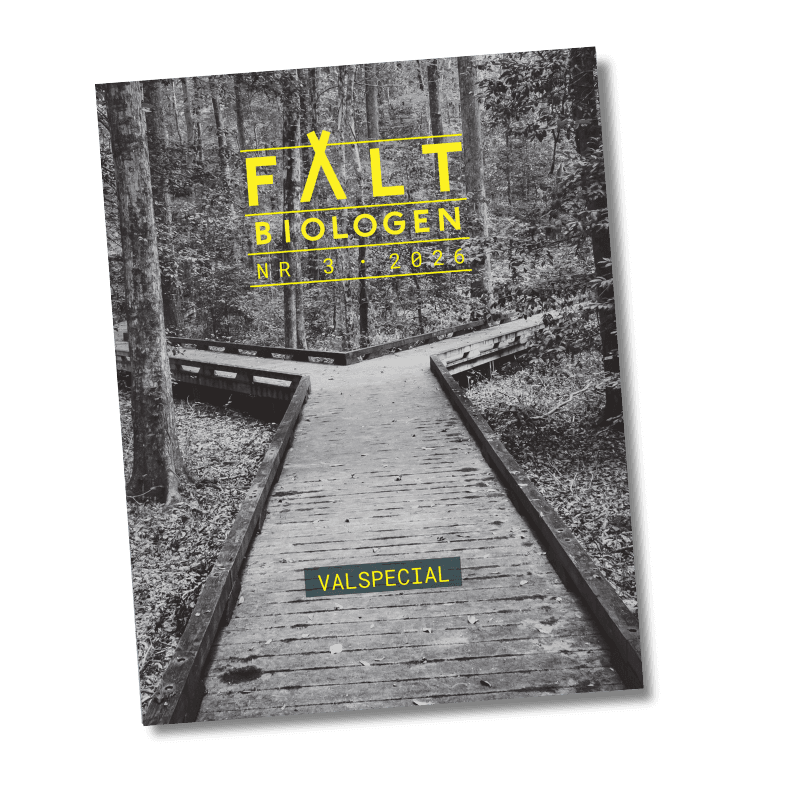
Tidningen Fältbiologen
Denna undersökning kommer från Fältbiologen: Valspecial (nr 3 2026).

Vill du stötta oss?
Fältbiologena drivs av unga ideella krafter. Du som är upp till och med 25 år kan stötta oss och bli medlem (och få nästa medlemstidning i brevlådan!) Att bli medlem är gratis.
Du kan också stötta oss som månadsstödjare.